Listen to the public debate over education freedom, and you might assume its constituency is narrow and deeply partisan. The National Education Association has called choice programs “at odds with what the majority of voters want.” American Federation of Teachers has said they are “a tax cut for the rich.” Opponents have pushed a familiar narrative about who these programs are for and where their support lies: wealthy families, metropolitan communities, and Republicans.
The data tell a different story.
Cut the numbers by income, race, geography, or party, and across nine of our most recent statewide polls, there is no group where fewer than six in 10 voters say parents rather than the government should choose the best school for their children. In some cases, the strongest support comes from the very groups that the narrative leaves out.
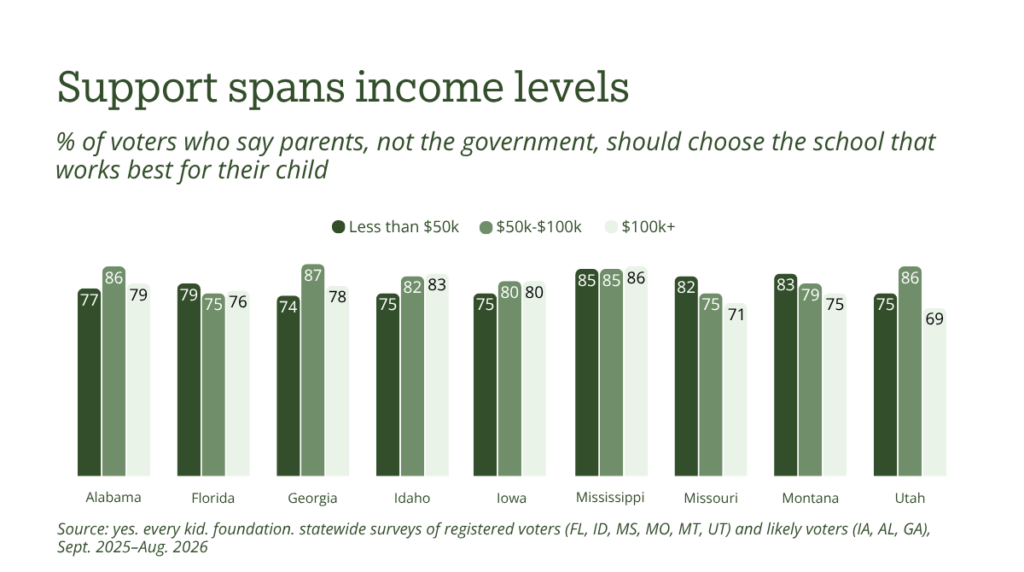
Over the past year, we surveyed voters in Alabama, Florida, Georgia, Idaho, Iowa, Mississippi, Missouri, Montana, and Utah. Support is strong regardless of how much voters earn. Voters earning under $50,000 back parental choice at 74% to 85% across the nine states, and voters earning $100,000 or more at 69% to 86%. In several states, the lowest income group is clearly the more supportive one: 83% to 75% in Montana, and 82% to 71% in Missouri. In Mississippi, support does not move with income at all: it sits between 85% and 86% at every income level.
The same pattern holds across race. Support runs at 73% or higher among both white and non-white voters in all nine states, and the two groups track closely. In Missouri, for example, 80% of non-white voters support parental choice, compared with 76% of white voters. In Georgia, the two land in the same place: 81% among white voters and 79% among non-white voters. And in Alabama, among Black voters specifically, support reaches 82%, a point higher than white voters in the state.
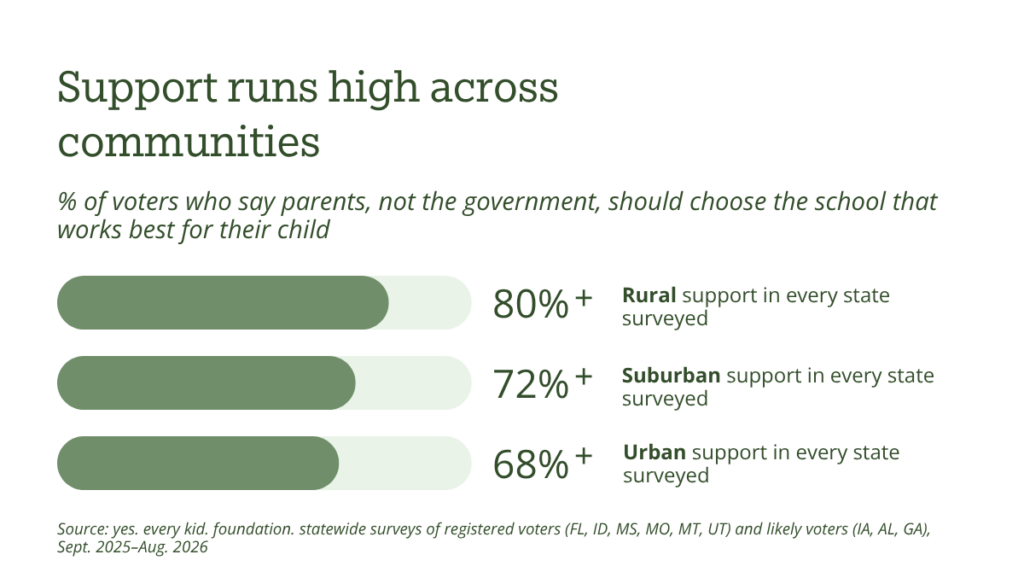
Geography is where the gap between the narrative and the evidence is particularly interesting. Rural communities are often portrayed as natural skeptics of expanding educational options. Ask rural voters directly, and at least eight in 10 say parents, not the government, should choose the school that works best for their children. Support is high in suburban and urban communities too, but rural voters are frequently the most supportive group in the state: 87% in Georgia, 85% in Idaho, 84% in Missouri, 82% in Utah and Montana, and 80% in Florida.
That leaves party, where strong Republican support often obscures just how broad the coalition is. Republicans are the strongest supporters of choice programs, with more than eight in 10 backing education freedom in the nine states polled. But a partisan gap is not the same as partisan opposition. Democratic support never falls below 63% in any of the nine states. Nearly seven in 10 Democrats in Alabama, Iowa, Georgia, and Utah support parental choice, and in Mississippi that figure rises to 76%.
Opponents have helped build a narrative of education freedom as an issue for a narrow slice of the electorate. But when voters themselves are asked what they want, the answer is consistent across every line we drew through the data: families, not government, should be empowered to choose the educational option that works best for their children.
Figures drawn from statewide surveys of registered or likely voters: Florida (Sept. 5–7, 2025; n=808 registered voters), Idaho (Sept. 22–24, 2025; n=604 registered voters), Mississippi (Oct. 27–30, 2025; n=600 registered voters), Missouri (Nov. 20–23, 2025; n=603 registered voters), Montana (Jan. 23–26, 2026; n=500 registered voters), Utah (Feb. 6–8, 2026; n=600 registered voters), Iowa (June 22–27, 2026; n=600 likely voters), Alabama (July 8-11, 2026; n=601 likely voters), and Georgia (Aug. 17–19, 2026; n=704 likely voters). All figures reflect total support for parents rather than government choosing the best education for their children. For more information on our research, please visit yeseverykidfoundation.org.