Over the past few years, states across the country have expanded families’ access to educational options through education savings accounts, tax credits, and other scholarship programs. As Americans head to the polls, we interviewed voters in several states to see what they think about the programs. Here’s what they said.
Voters strongly support education freedom programs in their states.
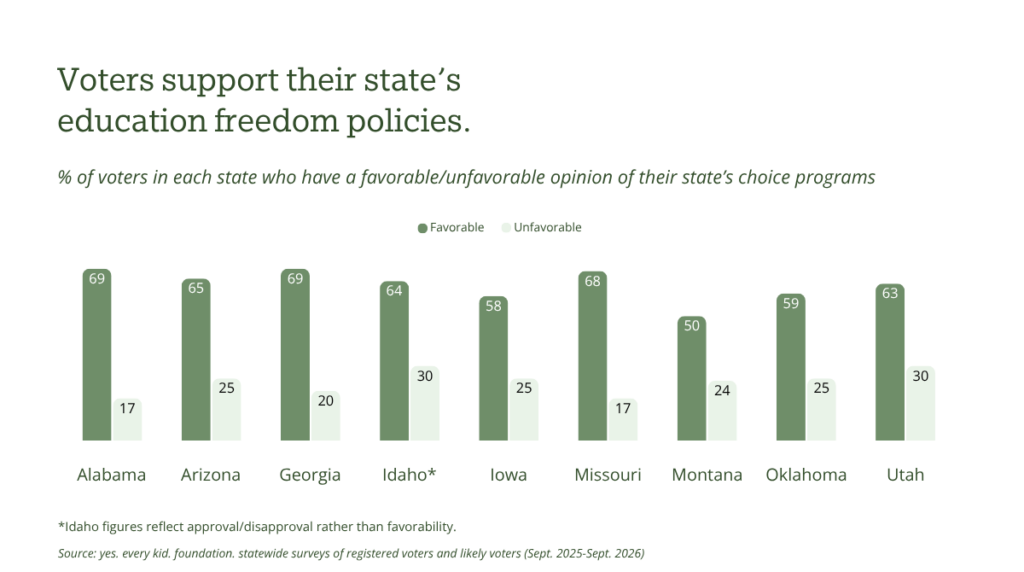
Across states, voters consistently give their program positive marks.
That’s true in states with longstanding programs and in states where education choice is relatively new. It’s true in states with universal eligibility and in those that have yet to get there. It also holds across different types of programs, from education savings accounts to tax credits.
In every state we polled, favorable views of the program outnumber unfavorable views by at least 2 to 1. In Alabama, for example, voters view the CHOOSE Act favorably by a 52-point margin. Georgia’s Promise Scholarship has a 49-point favorable margin, and Arizona’s Empowerment Scholarship Account program has a 40-point favorable margin.
Even with strong approval, voters want more.
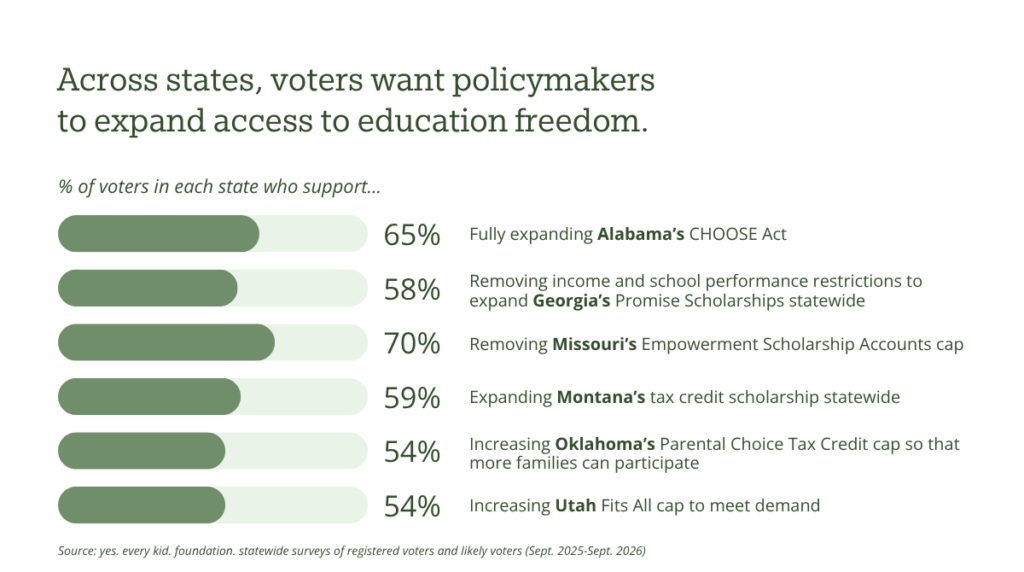
Support for existing programs doesn’t mean voters think the work is done. Across states, voters want policymakers to expand access.
In states that have yet to achieve universal eligibility, voters want lawmakers to remove restrictions so more families can participate. In Georgia, voters support expanding the Promise Scholarship statewide by removing current income and school performance requirements that currently limit eligibility. In Missouri, voters overwhelmingly support removing the cap on the Empowerment Scholarship Accounts Program, and a majority say it should be available to all families rather than limited by income.
Voters in states with universal eligibility want lawmakers to keep up the positive momentum.
That’s because universal eligibility doesn’t necessarily mean universal access. Funding limits, program caps, and other restrictions can prevent eligible families from participating. The polling shows voters want policymakers to remove those remaining barriers so that universal choice works in practice, not just on paper.
Alabama is a good example. Although the CHOOSE Act is open to families statewide, access is limited, and 15,000 students who sought scholarships were denied. Nearly two-thirds of voters support improving the CHOOSE Act so every child who wants to participate can do so, while just 19% oppose.
Voters do not want to go backward.
As education choice programs have grown, some lawmakers have proposed new restrictions or sought to narrow eligibility. But voters oppose efforts to roll back access.
In Iowa, for example, 57% of voters say the ESA program should remain available to every K–12 family, compared with fewer than a third who say it should be limited to low-income families. A majority of Oklahoma voters say the same about their state’s Parental Choice Tax Credit.
Consistently across states and programs, voters favor empowering families with greater choice and control over their children’s education. They support the programs they have, want more families to benefit from them, and oppose efforts to take those opportunities away. As Election Day approaches, candidates have an opportunity to listen to their constituents and respond to their priorities. For those elected, that means protecting and expanding access to education freedom.
Figures drawn from statewide surveys of registered or likely voters: Alabama (July 8–11, 2026), Arizona (February 25–27, 2026), Georgia (August 17–19, 2026), Idaho (September 22–24, 2025), Iowa (June 22–27, 2026), Missouri (November 20–23, 2025), Montana (January 23–26, 2026), Oklahoma (September 16-19, 2026), and Utah (September 25–29, 2026).