Ask Americans whether the country has drifted from what it was founded on, and the response is overwhelmingly shared. In a national survey of 1,000 registered voters conducted in July, as America marked its 250th anniversary, fully 80% agreed that America has moved away from many of its founding principles. Democrats said so at 84%. Republicans at 79%. Every major group agreed, from 71% of independents at the low end to 89% of seniors at the high end. It is one of the few things the country still says with one voice.
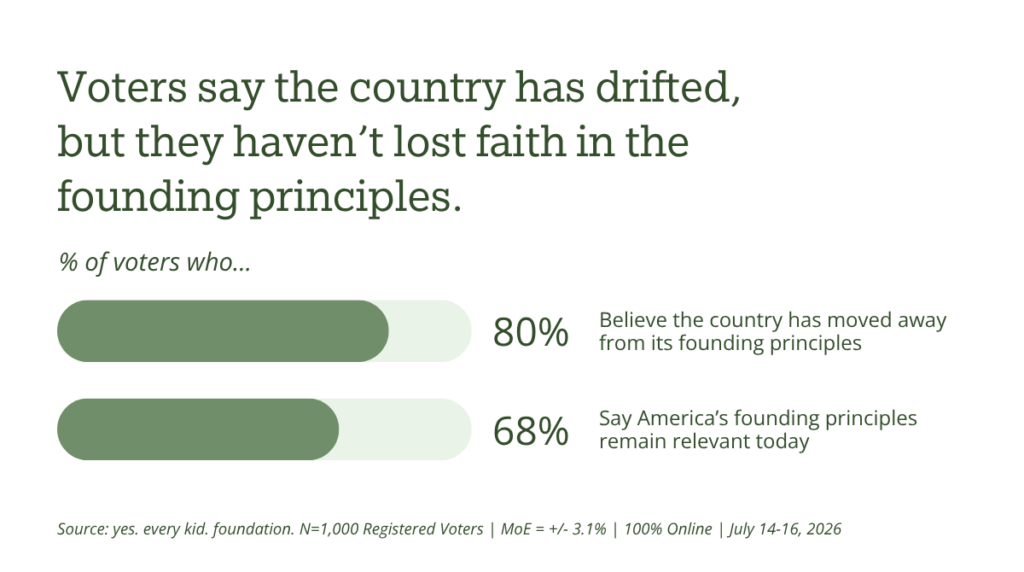
Yet even as Americans describe a country that has wandered off, 68% still say the founding principles remain relevant today. They have not given up on the ideas. They just think we have stopped living by them.
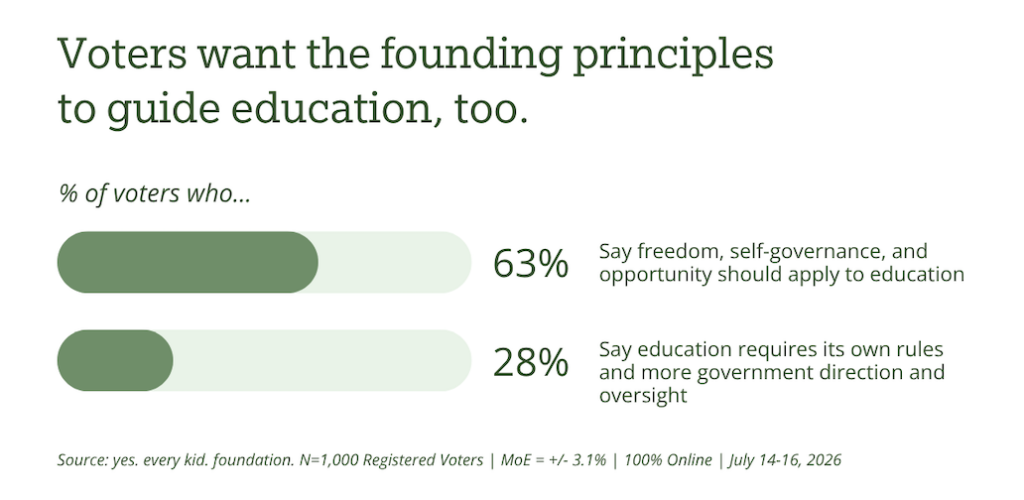
Education is one area where Americans want to put those ideas into practice. Our survey asked whether the same principles of freedom, self-governance, and opportunity that we apply to most aspects of American life should also guide education policy, or whether education is different, requiring its own rules and more government direction and oversight.
It was not close. A solid 63% said the same principles should apply to education. Only 28% said education needs to be governed differently. And that preference carried throughout the rest of the survey.
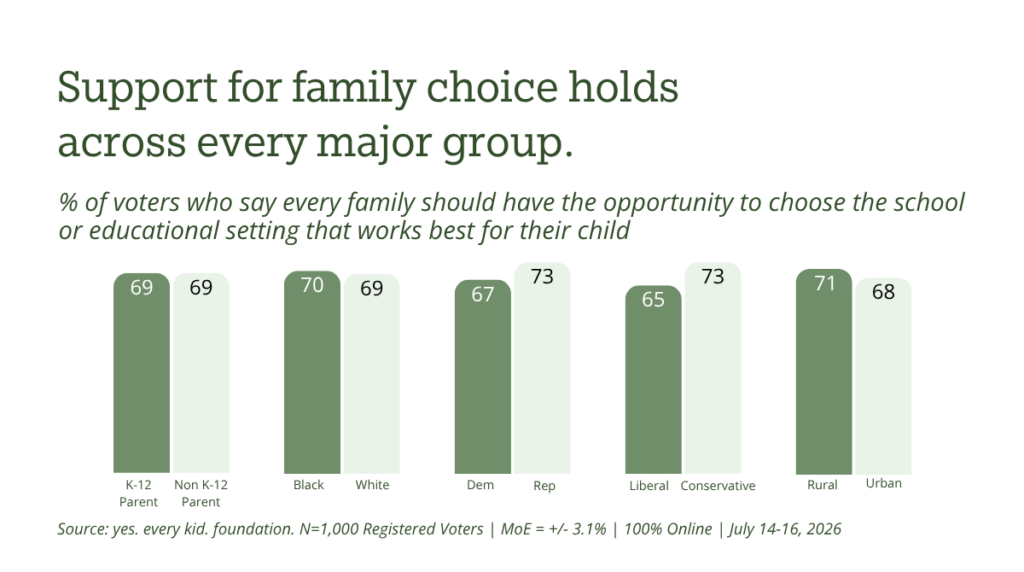
Nearly seven in 10 Americans said every family should have the opportunity to choose the school or educational setting that works best for their child. The same share said parents should generally have the final say over their child’s education, rather than state and local education systems. Another 71% said education freedom programs should be available to all families so every child has the opportunity to participate, while just 21% wanted them limited to families with the greatest financial need. And 69% said education freedom gives families more opportunities without taking away anyone else’s choices, compared with only 24% who said it weakens public schools by shifting students and funding away from them.
But perhaps the most striking finding is not any one of those numbers, but how consistently they hold across the country. Support is not concentrated in one party, ideology, race, or community. Across nearly every group we examined, Americans arrive at much the same place.
Republicans back family choice at 73% and Democrats at 67%. Conservatives come in at 73% and liberals at 65%. Black voters and white voters are separated by just one point, at 70% and 69%, respectively. Rural Americans come in at 71% and city dwellers at 68%. Parents with children in K–12 schools and those without children in K-12 schools land on exactly the same number, 69%. And the pattern holds among older and younger Americans, those with and without college degrees, Americans across the income spectrum, and those in every part of the country as well.
Drill down into geography and party together, and the pattern becomes sharper still. Rural Republicans support family choice at 78%. Urban Democrats support it at 69%. Those are two groups not often found on the same side of major questions in American life.
The survey also divided respondents based on whether they believe America’s founding principles remain relevant today. If support for family choice were simply an expression of reverence for the founding, the two groups should look very different. They do not.
Among Americans who say the founding principles remain relevant, 70% want families to be able to choose the school or educational setting that works best for their child. Among those who say the principles are no longer relevant, 68% want the same thing. On whether parents should generally have the final say over their child’s education, both groups land at exactly 70%.
People who have lost faith in the language of the founding have not necessarily lost the ideals behind it. Ask them who should decide where and how a child learns, and they still put that authority with the people closest to the child rather than the system itself.
As America looks ahead to its next 250 years, Americans are clear about the direction they want the country to take. Nearly two-thirds say the country should prioritize expanding freedom and opportunity over preserving existing systems and programs. In education, at least, they are remarkably clear about what that looks like: trust families, expand opportunity, and empower people with more freedom to choose.
Findings from a yes. every kid. foundation. survey of 1,000 registered voters nationally, online, July 14-16, 2026. Margin of error: +/- 3.1%.